 ENVIRONMENT
Equipment scope
Belt Filter Presses
Continuous sludge thickening and belt-pressure dewatering, with vertical or horizontal press layouts.
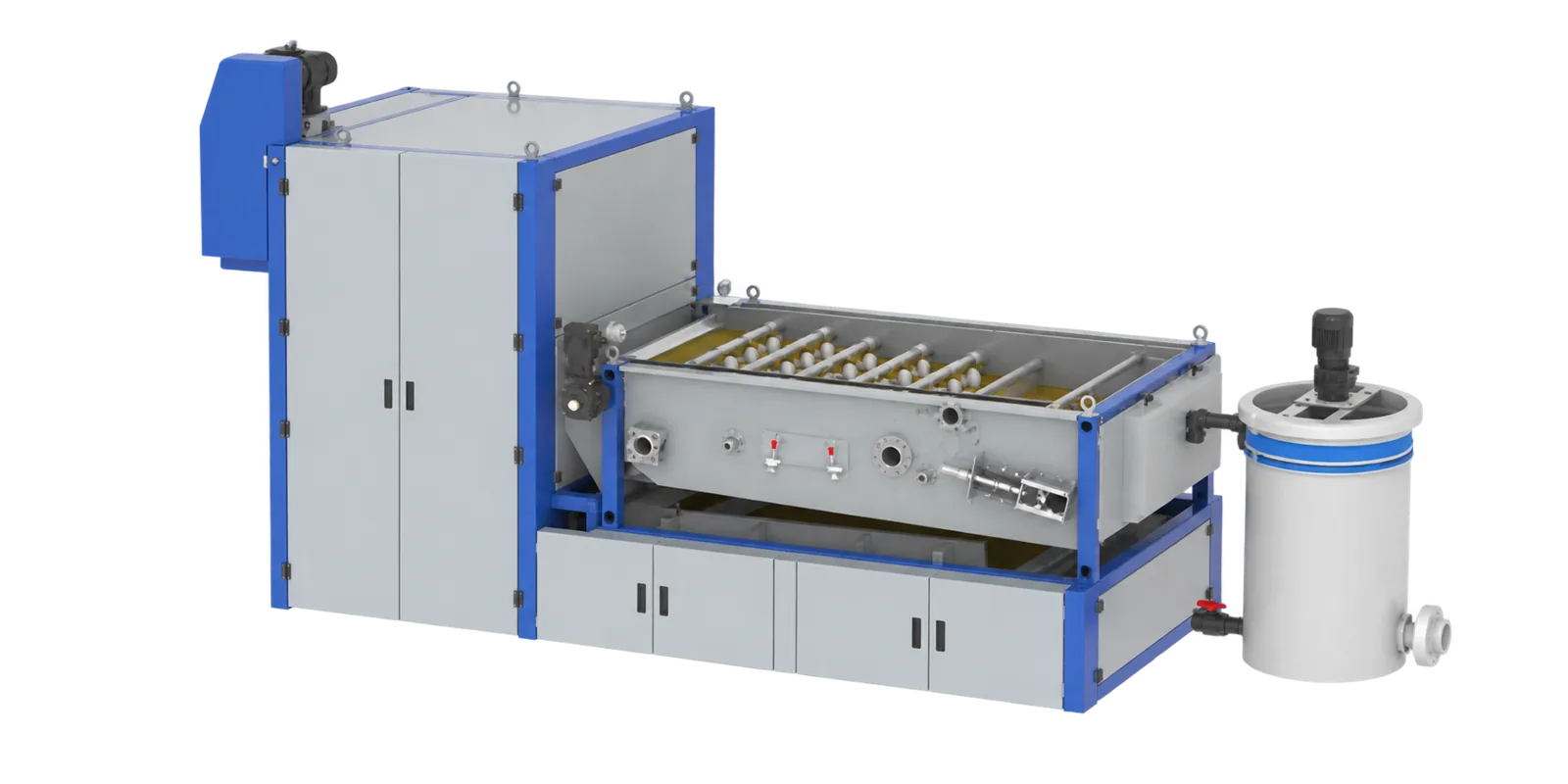
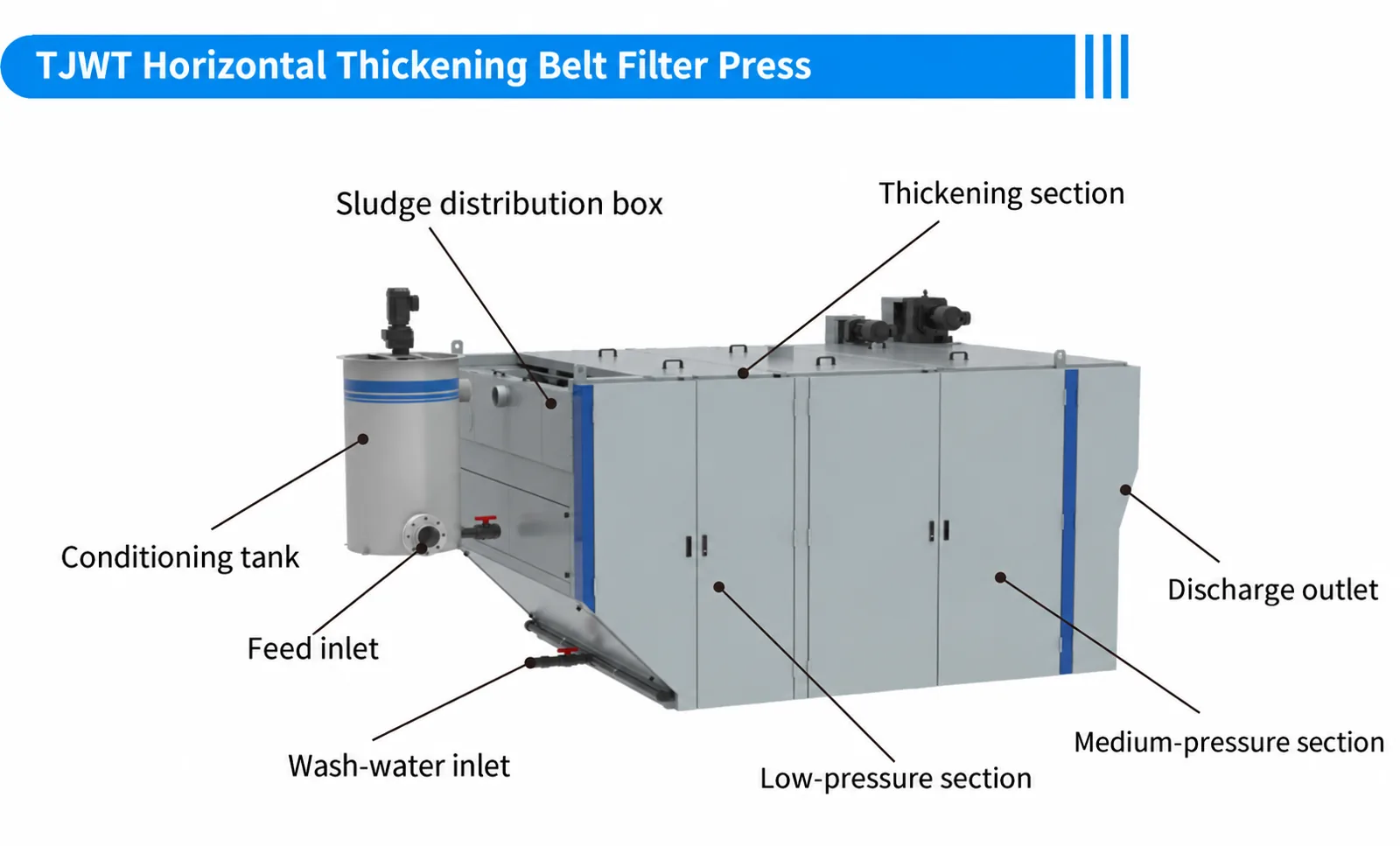
TJWT horizontal arrangement — labelled equipment diagram
Typical project applications
Sludge dewatering & handling.
Continuous belt dewatering
Conditioned sludge first passes through an extended thickening section, then between filter belts and a sequence of rollers for pressure dewatering. The catalogue offers vertical and horizontal press layouts, selected around installation space and upstream/downstream interfaces.
Catalogue configuration options
- Filter-belt widths: 1,000, 1,500, 2,000 and 2,500 mm
- Listed belt-speed range: 1.2–4.5 m/min
- Listed wash-water demand: 12, 18, 24 and 30 m³/h respectively
These are catalogue reference values. Sludge characteristics determine capacity, conditioning requirements and cake moisture; final selection requires a project-specific review.
Package coordination
Confirm sludge conditioning and polymer preparation, feed and cake handling, belt washing, filtrate collection, electrical controls and access for maintenance. The gallery shows the vertical and horizontal equipment arrangements.
Horizontal belt-press reference
| Model | Belt (mm) | Power (kW) | L × W × H (mm) |
|---|---|---|---|
| TJWT-1000 | 1,000 | 3 | 4,500 × 1,720 × 2,650 |
| TJWT-1500 | 1,500 | 3.7 | 4,500 × 2,220 × 2,650 |
| TJWT-2000 | 2,000 | 4.85 | 4,500 × 2,720 × 2,650 |
| TJWT-2500 | 2,500 | 4.85 | 4,500 × 3,220 × 2,650 |
These dimensions and powers describe the horizontal TJWT series, not every belt press. The catalogue lists 1.2–4.5 m/min belt speed. Sludge trials and the chosen auxiliaries determine the complete installation and electrical loads.
Key information for quotation
- Sludge type
- Sludge flow rate and feed solids content
- Target cake solids content