
Polymer costs are rising. Your dewatering equipment is burning through 6-10 kg per tonne of dry solids, and the monthly chemical bill keeps climbing.
Meanwhile, your operators are spending half their shift cleaning filter belts, unclogging spray nozzles, and dealing with equipment downtime.
There is a better option — and it has been gaining ground in municipal and industrial plants worldwide.
Screw press dewatering (also called multi-disc screw press or volute press) uses 40-60% less polymer than belt presses, requires minimal wash water, and runs with far less operator intervention.
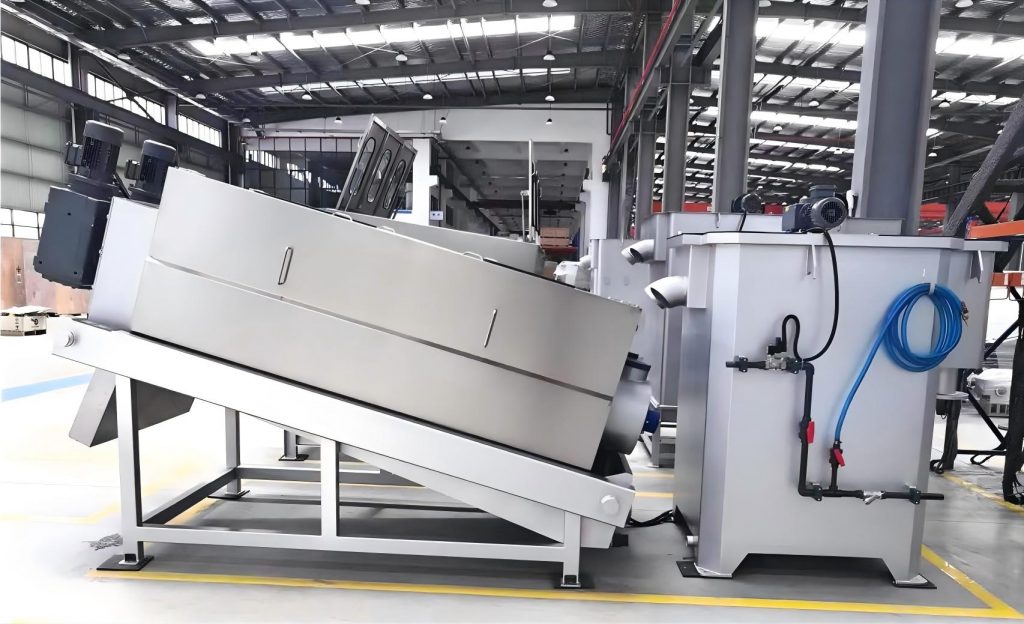
This article explains how screw press technology works, where it excels compared to other dewatering methods, and what matters when selecting and specifying a complete dewatering system.
How Screw Press Dewatering Works
The Core Mechanism
A screw press uses a slowly rotating screw shaft that moves sludge through a cylindrical filter drum made of stacked metal rings. As the screw advances:
- Thickening zone: Sludge enters and begins to concentrate as water drains through ring gaps
- Dewatering zone: Ring spacing gradually decreases, applying increasing pressure to squeeze out more water
- Cake discharge: Dewatered sludge exits as a semi-solid cake (typically 15-25% solids)
The key difference from belt presses or filter presses: continuous self-cleaning action. The rings move slightly back and forth, preventing clogging and eliminating the need for high-pressure wash water.
Why Screw Press Costs Less to Operate
1. Polymer Consumption: 40-60% Lower
Typical polymer dosing:
- Belt press: 6-10 kg per tonne dry solids
- Centrifuge: 4-8 kg per tonne dry solids
- Screw press: 2-5 kg per tonne dry solids
Why the difference?
Screw presses apply gradual, continuous pressure rather than high shear forces. This means floc stays intact, requiring less polymer to achieve stable dewatering.
Real-world impact:
For a plant processing 10 tonnes dry solids per day, switching from belt press to screw press can save 40-50 kg polymer daily. At current polymer prices, that is $15,000-25,000 per year in chemical savings alone.
2. Wash Water: 90% Reduction
Typical wash water consumption:
- Belt press: 1,500-3,000 L per tonne dry solids
- Screw press: 100-300 L per tonne dry solids
Belt presses need continuous high-pressure washing to prevent blinding. Screw presses use a small amount of wash water only for periodic rinsing.
Benefits:
- Lower water costs
- Less filtrate recycle load back to headworks
- Simplified piping and pump systems
3. Energy Consumption: 50-70% Lower than Centrifuges
Typical power consumption:
- Centrifuge: 25-45 kW for a mid-size unit
- Screw press: 3-7 kW for equivalent capacity
Screw presses operate at low rotational speeds (1-5 RPM for the screw, 0.5-2 RPM for the rings). No high-speed motors or gearboxes means lower energy draw and reduced wear.
4. Maintenance: Simpler and Less Frequent
No filter belts to replace. No high-speed bearings to service. No hydraulic systems for ram presses.
Typical maintenance:
- Inspect wear parts (screw flights, ring edges) every 6-12 months
- Replace worn components as needed (usually annually for municipal sludge, longer for industrial)
- Minimal daily operator attention beyond startup checks
Where Screw Press Excels (And Where It Does Not)
Best Applications:
Municipal wastewater sludge
- Waste activated sludge (WAS)
- Mixed primary and secondary sludge
- Digested sludge
Typical cake solids: 15-22%
Industrial biological sludge
- Food and beverage processing
- Pulp and paper
- Chemical manufacturing
Typical cake solids: 12-20%
Advantages for these applications:
- Continuous operation with minimal supervision
- Low polymer dosing keeps costs down
- Handles variable sludge characteristics well
Challenging Applications:
High-solids industrial sludge (already thickened to 8-12%)
Centrifuges may be more suitable for very high throughput at high inlet solids.
Fibrous or stringy sludge
Long fibers can wrap around the screw shaft. Pre-screening or chopping may be required.
Very small plants (less than 5 m³ per day sludge volume)
Economics may favor simpler technologies like belt presses or even manual plate presses.
Key Specifications That Affect Performance
1. Throughput Capacity
Screw presses are sized by sludge volume capacity, typically ranging from 5-100 m³ per hour.
Selection factors:
- Inlet sludge concentration (higher concentration = higher dry solids throughput)
- Desired cake dryness (pushing for higher cake solids reduces capacity)
- Sludge characteristics (digestibility, organic content, particle size)
2. Ring Gap and Pitch
The spacing between rings determines filtration rate and cake dryness.
- Wider gaps (1.0-1.5 mm): Higher throughput, slightly wetter cake
- Narrower gaps (0.5-0.8 mm): Drier cake, lower capacity, more frequent cleaning
Most municipal applications use 0.8-1.2 mm gaps.
3. Materials of Construction
Rings and screw flights are subject to wear, especially with abrasive sludge.
Standard materials:
- Stainless steel 304 or 316 (suitable for most applications)
- Hardened stainless or wear-resistant coatings for abrasive sludge
Tip: Ask suppliers about expected wear rates and replacement part costs. These are ongoing expenses.
4. Polymer Dosing and Mixing System
Screw press performance depends heavily on proper polymer conditioning.
Critical design elements:
- Polymer dilution and aging: Proper makeup system with controlled dilution (typically 0.2-0.5%)
- Static or dynamic mixer: Ensures uniform polymer distribution before sludge enters the press
- Dosing control: Flow-proportional dosing tied to sludge flow rate
Poor mixing is the number one cause of screw press underperformance.
The Hidden Costs of Incomplete Systems
Many suppliers quote screw press equipment as a standalone unit. But a functional dewatering system requires much more:
What is often missing from quotes:
- Sludge feed pumps sized for proper flow control
- Polymer preparation and dosing systems
- Inlet flocculation mixer
- Cake conveyors or hoppers
- Filtrate collection and return piping
- Control panels with automated startup and shutdown sequences
The problem:
If these components are undersized, incompatible, or poorly integrated, the screw press will not perform as expected — even if the press itself is well-designed.
You end up spending months troubleshooting, sourcing missing components, and dealing with finger-pointing between multiple suppliers.
How G-LINK Delivers Complete Dewatering Systems
We do not just supply screw press equipment. We deliver fully integrated, ready-to-operate dewatering systems.
Our Approach:
1. System Design, Not Just Equipment Selection
We start by understanding your full dewatering process:
- What is your sludge source and characteristics?
- What are your target cake solids and disposal requirements?
- What level of automation and operator involvement do you need?
Based on this, we design the complete system — not just pick a press model from a catalog.
2. One-Stop Integration: All Components Matched and Tested
Once the main screw press is selected, we handle the entire package:
Polymer conditioning system:
- Polymer dissolving and aging tanks (with proper mixing)
- Dosing pumps (peristaltic or progressive cavity, matched to polymer type)
- Dilution water supply and flow control
Sludge feed system:
- Feed pumps sized for your flow rate and sludge viscosity
- Flow meters and control valves
Cake handling:
- Screw conveyors, belt conveyors, or hoppers based on your layout
- Proper sizing to prevent bridging or clogging
Filtrate management:
- Collection tanks or troughs
- Return pumps to headworks or upstream process
Control and automation:
- PLC-based control with automated startup, shutdown, and alarm management
- Remote monitoring options (if desired)
- Integration with your plant SCADA system
3. Pre-Shipment Factory Testing
We coordinate factory acceptance testing (FAT) where possible, ensuring:
- All components function together as a system
- Control logic operates correctly
- No mismatched flanges, voltages, or incompatible materials
4. Commissioning Support
Dewatering equipment requires optimization during startup:
- Polymer dosing adjustments
- Screw speed and back-pressure tuning
- Wash water frequency settings
We provide technical guidance and remote support to help get your system running at target performance.
5. Ongoing Technical Support and Polymer Supply
Once your system is running:
- Troubleshooting assistance for performance issues
- Spare parts sourcing and supply chain management
- Polymer supply: If needed, we can provide flocculants through our partnerships with reputable Chinese polymer manufacturers offering excellent quality-to-price ratios
The goal: You focus on running your plant. We handle the equipment complexity.
Screw Press vs. Belt Press vs. Centrifuge: Quick Comparison
| Factor | Screw Press | Belt Press | Centrifuge |
|---|---|---|---|
| Polymer use | Low (2-5 kg/tDS) | High (6-10 kg/tDS) | Medium (4-8 kg/tDS) |
| Wash water | Very low | High | Low |
| Energy | Low | Low | High |
| Cake dryness | 15-22% | 18-25% | 20-30% |
| Maintenance | Simple | Moderate | Complex |
| Operator attention | Minimal | Moderate | Minimal |
| CAPEX | Medium | Low | High |
| Best for | Continuous, variable sludge | Budget-sensitive, high cake dryness | High-solids, large capacity |
Final Thoughts
Screw press dewatering is not a perfect fit for every application. But for municipal and industrial biological sludge, it offers a compelling combination of low operating costs, simple maintenance, and reliable performance.
The key to success: Proper system integration.
A well-designed screw press with properly sized polymer dosing, sludge feed, and cake handling will deliver years of trouble-free operation. A poorly integrated system — even with a high-quality press — will frustrate operators and underperform.
If you are evaluating dewatering options, make sure you are comparing complete systems, not just equipment prices.
Considering screw press dewatering for your plant? Contact us to discuss your sludge characteristics and system requirements, or explore our complete sludge management solutions.
Related resources:
- Polymer Selection for Sludge Dewatering: Cationic, Anionic, or Non-Ionic? (coming soon)
- Troubleshooting Low Cake Solids: Dosing, Mixing, or Equipment Issues? (coming soon)